FAQ

A potato baker is one of the simplest ways to increase food sales without complicating your menu.

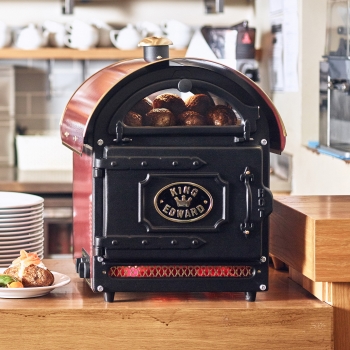
The oven attracts attention from across the room. Customers can see real potatoes baking and being held hot, which often encourages them to upgrade from just a drink to a full meal.

A King Edward baker will cook, store and promote the sale of baked potatoes in one compact unit. It plugs into a standard 13 amp socket and sits neatly on your counter, making it easy to introduce without major changes to your kitchen.

Customers can see that the potatoes are properly baked rather than microwaved. When paired with fresh toppings from your servery, it creates a simple, honest meal that feels considered and good value.

In short, it becomes your silent salesman.

The capacities shown on our website are based on 6 to 8 oz baking potatoes, often referred to as a “60 count” box size, cooked without foil.

All of our electric ovens are convection ovens and do not require foil. Our gas model also does not require foil, although some operators choose to use it.

If you decide to use larger potatoes, the number you can load per batch will reduce. Smaller potatoes will increase the number per batch.

Other factors that may affect capacity include:

  • Variation in potato size within the same delivery
  • How closely the trays are loaded
  • Whether potatoes are wrapped in foil

Using foil will increase cooking time and can slightly reduce the number of potatoes that fit on each tray.

If you plan to serve larger potatoes as standard, allow for a lower batch quantity when selecting your oven model.

Washed and graded baking potatoes require very little preparation.

For best results, we recommend:

  • Selecting evenly sized baking potatoes
  • Lightly rubbing the skins with cooking oil
  • Sprinkling with a small amount of salt before baking
  • Oiling and salting the skins helps create a crisp, flavourful finish.

Pricking the skin before cooking can help reduce the risk of a potato splitting during baking.

Foil is not required in our ovens. In recent testing, potatoes wrapped in foil took longer to cook. While foil can help retain slightly more moisture during holding, it prevents the skins from becoming crisp.

For a traditional baked potato with crisp skin and a fluffy centre, we recommend cooking without foil.

In our ovens, a typical 6 to 8 oz baking potato, often referred to as a “60 count” box size, will take approximately 1 hour to 1 hour 10 minutes to cook at 200°C.

If potatoes are wrapped in foil and cooked at 200°C, allow around an additional 50 minutes.

In our testing, foil wrapped potatoes cooked at 250°C took a similar amount of time to non-foil potatoes at 200°C. However, cooking without foil at 200°C produces a crisper skin.

Cooking time will vary depending on:

  • The exact size of the potatoes
  • How evenly sized the batch is
  • The oven model
  • Whether foil is used

If you are using larger box sizes, such as 50s (approximately 8 to 10 oz) or 40s (approximately 10 to 12 oz), you should allow additional cooking time and expect a reduced batch quantity.

As baking time increases, the jacket becomes thicker and firmer.

For consistent results, we recommend using evenly sized 6 to 8 oz potatoes and avoiding foil where possible, as this allows the skin to crisp properly and keeps cooking times predictable.

Yes. Baked potatoes are a naturally nutritious, filling food and the skins are an excellent source of fibre.

Potatoes are also rich in potassium and, gram for gram, contain more potassium than a banana.

Typical nutritional values for a raw main crop potato such as Maris Piper, King Edward, Desiree or Cara are approximately:

Energy Water Protein Carbohydrate Fibre Vitamin C
75kcal 79g 2.1g 17.2g 1.6g 11mg

Values will vary slightly depending on variety and size.

Baked potatoes are also naturally gluten free, making them a versatile and inclusive menu option for a wide range of customers.

Yes. Offering both hot and cold toppings gives customers more choice and increases the value of each sale.

Hot fillings such as baked beans, chilli and curries are all popular options and are straightforward to hold at temperature during service. Cold toppings such as cheese, coleslaw and tuna provide contrast and allow customers to customise their meal.

Our Vista Compact & Classic Compact models include integral bain marie units designed specifically for hot toppings. Alternatively, we offer a range of Prestige and Classic bain maries in colours and finishes to match your King Edward potato baker.

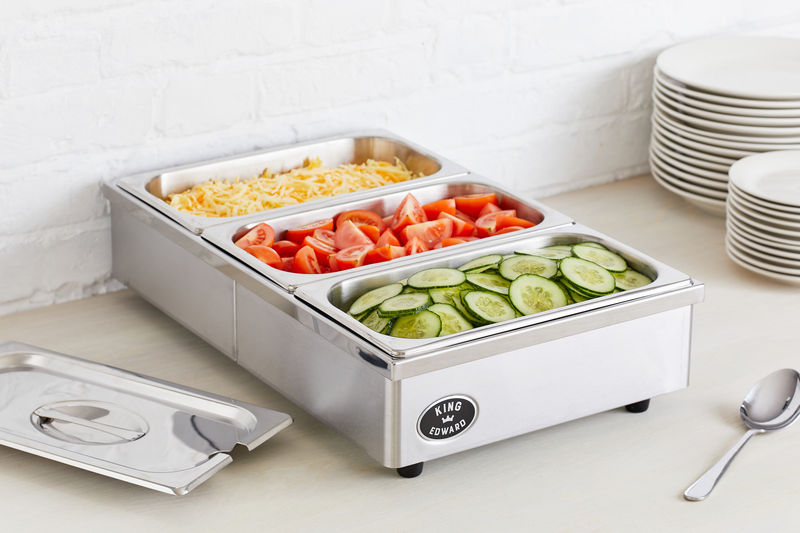
We also supply a full range of servery equipment, including countertop bain maries, chilled topping displays and food display units, allowing you to create a complete, coordinated setup.

Please note that a bain marie is designed to hold food at temperature, not to cook it from cold. Fillings must be heated to the correct temperature before being placed into the unit.

In most cases, no specific additional ventilation is required.

Our electric convection ovens can be installed in a normally ventilated room without the need for dedicated extraction. They will produce some steam during baking, but this is minimal in a typical catering environment.

If possible, positioning the oven near general ventilation or extraction will help manage steam in high volume settings, but it is not a strict requirement.

For the best installation:

  • Allow adequate space around the oven for airflow
  • If siting beneath an extraction canopy, ensure there is at least 300 mm of clear space above the unit
  • Do not block any vents on the oven

The same guidance applies to our gas model, although as with any gas appliance, installation should be carried out in accordance with current gas safety regulations.

If you are unsure about your specific site conditions, we are happy to advise before installation.

If your budget allows, choose the largest capacity baker you can accommodate. The difference in price, footprint and running costs between models is relatively small, and any unused capacity can be used for additional batches or other menu items.

Plan your production around your serving time. For example, if you begin serving at 11.30am, aim to have your first batch baked and in the display oven by around 10.45am. Load the next batch immediately so it is ready as the display oven empties.

This simple rotation helps you maintain continuous availability during busy periods.

Once baked and on display, we recommend serving potatoes within approximately 1.5 hours for best quality.

Any unused potatoes can be repurposed. They can be:

  • Refrigerated, sliced, brushed with oil and paprika, and baked briefly to create wedges
  • Used in soups or stews to add body and texture

Good planning, consistent sizing and staggered batches will help you make the most of your oven throughout the day.

Certification shows that the oven has been independently tested and meets the required safety and performance standards for commercial use. It confirms the appliance is legal to place on the market and safe to operate.

What do UKCA, CE and UKNI actually mean?
These are the recognised conformity marks for different regions.
• UKCA applies in Great Britain
• CE applies in the EU
• UKNI applies in Northern Ireland when a UK approved body carries out the assessment

Does a certified oven go through extra testing?
Yes. Gas appliances undergo detailed checks on combustion quality, construction, materials, durability, efficiency and safe operation. These assessments are completed by an independent approved or notified body.

Why is independent testing important?
It protects operators by ensuring the oven meets strict safety requirements. It also supports insurance and inspection needs, because the appliance has been formally assessed rather than self declared.

What documentation sits behind these marks?
Every certified oven must have a full technical file and a Declaration of Conformity to show it meets the regulations. This provides clear proof of compliance if an issue is ever raised.

Are King Edward ovens certified?
Yes. All King Edward gas ovens are tested and certified to UKCA, CE and UKNI standards. This guarantees they meet the legal requirements for the UK and EU markets and have passed independent safety and performance testing.

Our ovens operate at temperatures of up to 250°C, so some external surfaces may become warm during use.

King Edward ovens use convection to circulate hot air efficiently within the cavity. This method of cooking reduces the amount of direct heat transfer to the outer casing compared with less efficient designs.

As with any commercial cooking equipment, care should be taken when handling the oven. Staff should use appropriate oven gloves or gauntlets when loading and unloading trays.

When siting your baker, use common sense. If the oven is positioned on a front counter where members of the public could reach it, you may wish to consider fitting a low glass or perspex screen along the counter edge. This can help prevent accidental contact and may also provide added protection for other food items or equipment on display.

If you are unsure about placement within your space, we are happy to advise.

We developed our own convection system many years ago and continue to use it across our range. Careful design of airflow and heat input ensures consistent, even baking throughout the oven chamber.

Convection ovens circulate hot air around the cavity, rather than relying on static heat. This prevents hot spots and reduces the risk of over or under cooking.

In practical terms, this means:

  • Even baking across every tray
  • No need to rotate or move potatoes during cooking
  • More efficient use of energy
  • Consistent results batch after batch

Because of their controllability, our convection ovens are also versatile and can be used to cook a range of other foods, not just jacket potatoes.

All King Edward electric ovens are designed to run on standard UK power supplies, with most models operating from a 13 amp plug.

Below is the maximum electricity cost per hour based on a 30p per kWh tariff:

These figures show the maximum possible draw if the oven ran at full power continuously for one hour.

In normal operation, once up to temperature, the thermostat cycles on and off. This means the average running cost is typically lower than the figures shown above.

Proud to supply…

Our Products